A New Way to Look at the True Value of Corporate Aviation
THE ROBAI™ FRAMEWORK SERIES • ARTICLE 1 OF 7 • INTRODUCTION
By Bas de Bruijn, Head of Aviation Advisory Services, Clay Lacy Aviation
For decades, the business case for corporate aviation has rested on a familiar set of arguments; time savings, productivity, schedule flexibility. Access to destinations commercial airlines don’t serve. These are real benefits, and the research supporting them is legitimate. A substantial body of industry work has demonstrated that companies utilizing business aircraft tend to outperform those that don’t — in EBITDA, in return on equity, in the pace at which they execute.
If you run a flight department, you’ve made these arguments. If you sit in the C-suite, you’ve heard them.
And yet, flight departments remain among the first line items reviewed when an activist investor arrives, when a CFO is tasked with finding cuts, or when a board decides to scrutinize overhead. The arguments haven’t failed because they’re wrong. They’ve failed because they’re incomplete.
The metric problem
Corporate aviation has always been measured the way it was built to be operated — efficiently. Flight hours, cost per flight hour, utilization rates, load factor. These are the numbers that appear in budget reviews, and they tell a coherent story: here is what this asset costs, and here is how hard we are working it.
What they don’t tell you is what the asset is doing for the business.
That distinction matters more than most organizations realize. An aircraft that flies 400 hours a year at a low cost per hour may be delivering extraordinary strategic value — or it may be running efficiently while contributing very little to the decisions, relationships, and opportunities that drive enterprise performance. The operational metrics cannot tell you which is true. They were never designed to.
This is the gap that has left corporate aviation perpetually vulnerable. Not because business aviation value isn’t there. Because no one has built a credible framework for seeing it.
The TANGIBILITY Paradox
The measurement problem is real. But it is a symptom of something deeper — a structural paradox that no amount of operational efficiency can resolve on its own.
The Tangibility Paradox is rooted in Fons Trompenaars’ dilemma reconciliation theory — the idea that opposing tensions are not resolved by choosing one side, but navigated by finding a path through both. I was first introduced to this thinking during a guest lecture by Trompenaars in my MBA, and it became the lens through which I began to see the cost-versus-value debate in corporate aviation not as a problem to be solved, but as a permanent tension to be managed.
The costs are immediately visible. Fixed expenses, hourly rates, capital investment — these appear clearly in every budget review, every overhead analysis, every line-item comparison. They are easy to find, easy to measure, and easy to question.
The value is real but unquantified. Leadership effectiveness, decision velocity, executive engagement, organizational alignment, information security — these do not appear in an operations report. Every CFO in the room knows they exist. The problem is not that the value is hidden. It is that no one has built a credible framework for expressing it in language that survives a budget review.
Legitimacy — the verdict rendered by the C-Suite, boards, investors, employees, and the public on whether the capability is justified — sits in the balance between the two. And because cost is always tangible while value is not, legitimacy is structurally harder to earn than it should be.
This is the Tangibility Paradox. And it is the reason the familiar arguments have failed — not because they are wrong, but because they have never addressed the asymmetry at the root of the problem.
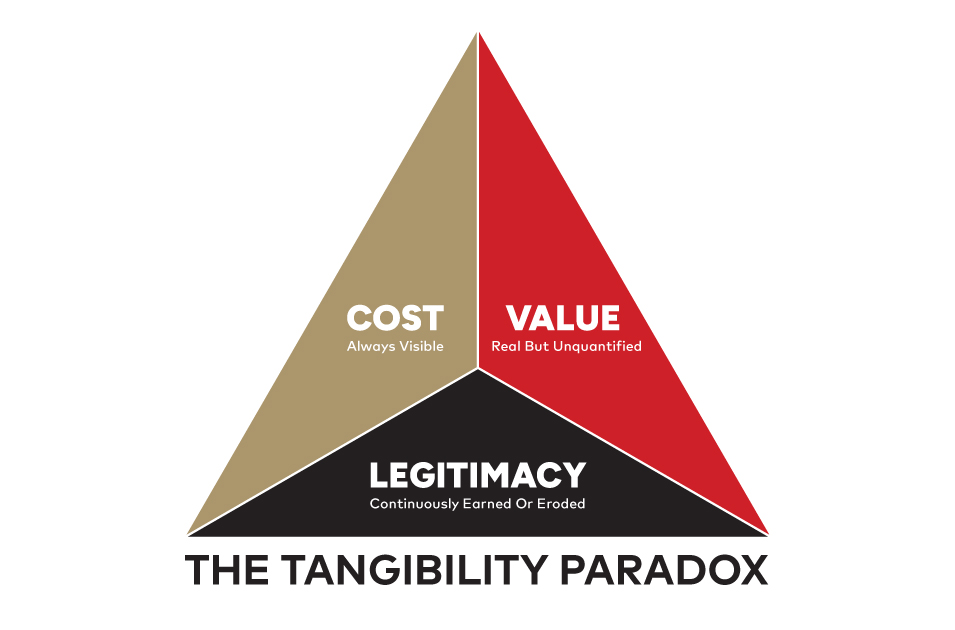
Every leader responsible for a corporate aviation program is navigating three simultaneous pressures that flow directly from this paradox. The first is cost: boards and CFOs want to understand what the operation truly costs, and whether that cost is managed with the discipline appropriate to its scale. The second is value: executives who rely on the capability know it matters, but struggle to articulate what it returns in language that survives a budget review. The third is legitimacy: in an environment of heightened scrutiny of business aviation as well as around executive compensation and corporate governance, the question of whether a capability like this can be credibly justified — to investors, employees, and the public — is more consequential than it has ever been.
These three pressures do not resolve each other. And they will not resolve until the value side of the paradox is expressed in financial terms — in language that is credible to a CFO, defensible to a board, and grounded in research that can withstand scrutiny.
That is the problem this series is designed to address. The articles that follow build the value case with the analytical depth it has always deserved. But value alone is not the destination. The destination is a corporate aviation function that can account for what it costs, demonstrate what it returns, and sustain the confidence of every stakeholder who has a legitimate claim on that judgment.
What the research reveals
My published research in the Journal of Air Transport Management examines the relationship between corporate aircraft access, business travel stress, and employee well-being. It draws on two well-established frameworks from organizational psychology: the Job Demands-Resources Model and the Person-Environment Fit Model.
What the research found goes well beyond the productivity conversation.
Business travel on commercial airlines is not simply inconvenient. It is, for many senior executives, a meaningful and sustained source of cognitive depletion, emotional exhaustion, and work-family conflict. The demands of commercial travel — time pressure, unpredictability, loss of environmental control — actively drain the resources that leaders need to perform. By the time an executive arrives at a critical meeting after a delayed connection, a middle seat, and a 5 a.m. alarm, they are not the same leader who walked out of the office the day before.
Corporate aircraft access changes that equation. The research found that control over the travel environment appears to restore those resources, reducing fatigue, alleviating work-family tension, and enabling executives to arrive cognitively present and ready to engage. Participants described not just comfort, but a fundamentally different quality of professional performance.
That difference has implications that reach well beyond the flight itself.
A new framework for a familiar asset
Building on this research, and on Dave Ulrich’s foundational work on Return on Intangibles, I developed the ROBAI™ framework — Return on Business Aviation Intangibles. It proposes and estimates the connection between corporate aircraft access and EBITDA and enterprise value across five value drivers that traditional metrics have never captured:

Each one is grounded in the research. Each one points toward financial consequences that most companies have never modeled. Taken together, they reframe the flight department not as a cost center to be defended, but as a strategic resource to be understood.
The estimates that emerge from applying this framework are not the cost-per-hour figures that appear in a budget review. They are the kind of numbers that belong in a conversation about enterprise value. A credible, research-grounded picture of the value of corporate aviation at stake that changes the nature of that conversation.
Why this matters now
The pressure on corporate flight departments is not going away. Boards are asking harder questions. Investors are scrutinizing overhead with greater sophistication. The executives who rely most on corporate aircraft access are rarely the ones making the case for it.
Flight department leaders have long known that what they do matters. The challenge has been proving it in language that the boardroom and C-Suite understands and respects.
The research foundation now exists to support that case — and the framework to structure it. And the conversation — about what corporate aviation returns to the organizations that use it — is one that Clay Lacy Aviation Advisory Services was built to lead.
If you are evaluating your aviation program, preparing to make the case for it, or wondering whether you are getting everything you should from the asset you already have, this is where that conversation starts.
The ROBAI™ framework starts with a conversation. If you’re ready to look at your aviation program through a different lens, Clay Lacy Aviation Advisory Services is ready to have it. Get in touch.